
Key Takeaways
The Way Pain Treatment Used to SpreadMy grandfather treated kung fu students in the 1940s. No advertising. No demonstrations. Just referrals.If someon...

The Way Pain Treatment Used to Spread
My grandfather treated kung fu students in the 1940s. No advertising. No demonstrations. Just referrals.
If someone got better, they told a friend—but they didn’t just say “this worked.” They shared context: where the pain was, how it started, what kind of body the person had, what they could and couldn’t do.
That shared context mattered.
When my father ran the clinic from the 1980s onwards, it was the same. Growth came from word of mouth. People didn’t just recommend a place—they shared their experience. And the person listening could intuitively decide: “That sounds like what I’m dealing with.”
Those conversations quietly filtered expectations. People didn’t expect instant fixes for long-standing problems, because they had heard how long recovery actually took. They didn’t assume one method worked for everyone, because they had seen when it didn’t.
That filter is largely gone now.
How Social Media Broke the Old Filter
It didn’t fade gradually. It was replaced.
Social media changed what gets rewarded—not accuracy, but whatever stops the scroll. Platforms amplify spectacle. Pain care became performance. The louder the crack, the better it performs. The more dramatic the reaction, the more convincing it looks. The faster the relief appears, the more it feels like proof.
What disappears is everything that actually matters:
how long the pain existed
whether it was acute or chronic
whether the relief lasted
whether function improved weeks later
Social media collapses recovery—which happens over time—into a single moment. When people see that repeatedly, expectations shift. That’s how chronic conditions like frozen shoulder, disc-related pain, or long-standing knee pain end up being treated as if they were fresh injuries. Non-instant recovery starts to feel like failure. Care that explains, paces, and progresses begins to look weak by comparison.
This isn’t a coincidence. It’s the inevitable result of an algorithm that rewards spectacle over truth.
Why Loud Treatments Feel Like They Should Work
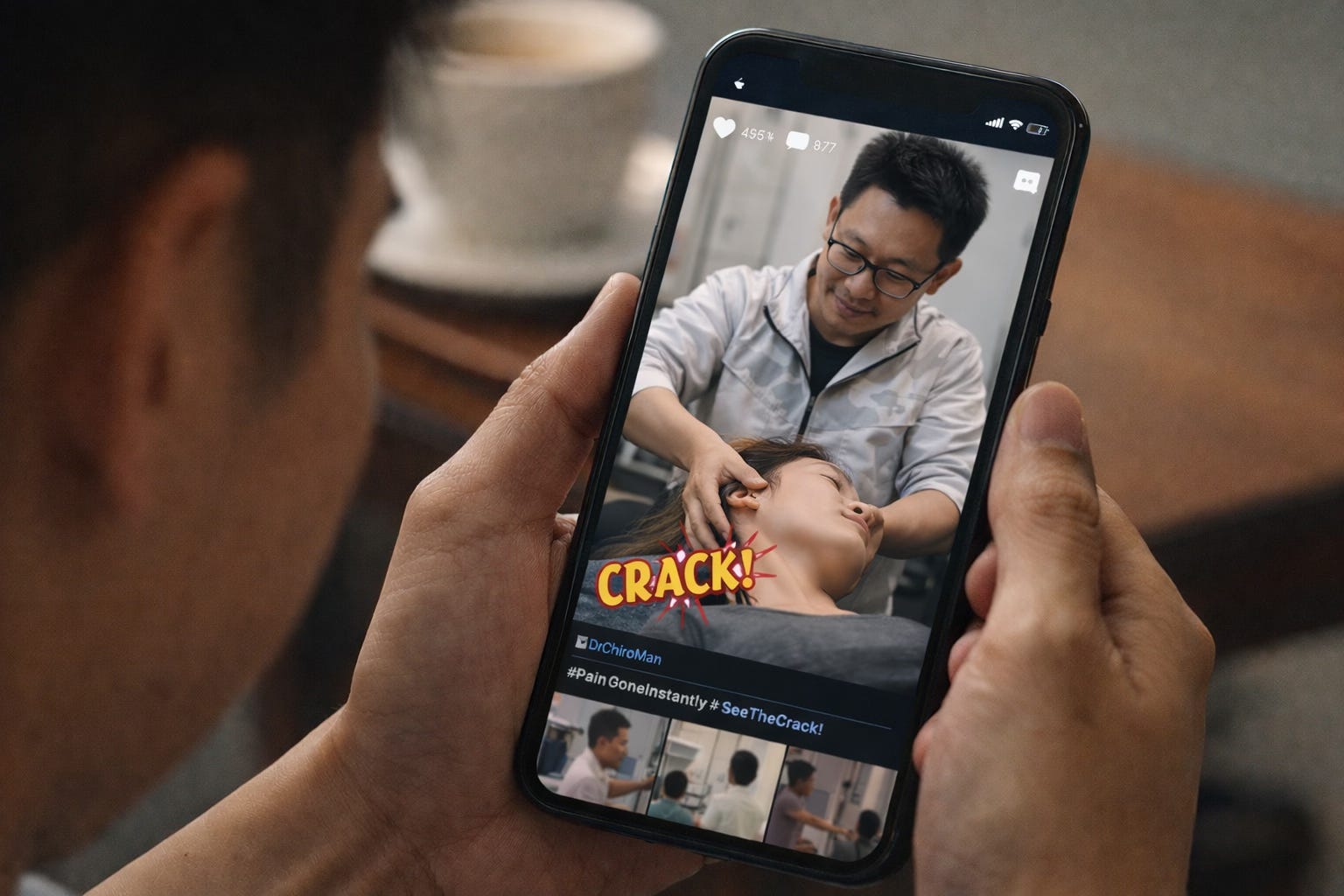
Here’s why these videos are so persuasive: they create clear sensory signals—sound, force, visible movement, immediate sensation change. Our brains interpret those signals as “something meaningful happened.”
Sometimes, for certain kinds of pain, that interpretation is correct. A nervous system can quiet temporarily. Muscles can relax. Movement can feel easier.
But sensation is not the same as resolution.
A moment of relief doesn’t tell us whether the underlying issue changed, whether the pain will return, or whether function will actually improve. Yet the screen trains us to equate immediacy with effectiveness.
How This Leads People to the Wrong Question
This is why people ask “Should I do chiropractic or physio?” or “Is PRP better than shockwave?” instead of asking:
What kind of pain am I actually dealing with?
Once that shift happens, confusion is almost guaranteed. Different treatments target different systems. And pain doesn’t come from the same place in everyone—even when the diagnosis sounds identical. In our clinics, sometimes the hardest part of treatment is often not the work itself, but resetting expectations shaped by what patients have seen online.
People bounce from option to option, not because treatments don’t work, but because the match was wrong. Short-term relief comes and goes. Hope rises and falls. Confidence erodes. And eventually, people start doubting themselves.
The Quieter Starting Point That Actually Helps
There’s a calmer, less dramatic question that changes everything:
What seems to be driving this pain — right now?
Not forever. Not perfectly. Just enough to stop chasing the wrong thing.
When you start there, treatments stop feeling random. Progress becomes easier to interpret. And recovery starts to make sense again.
Where This Goes Next
Next, I’ll show you how to recognize what’s actually driving your pain—not to diagnose yourself, but to stop cycling through fixes that were never designed for your problem in the first place.
Because pain isn’t solved by the loudest solution.
It’s solved by the one that actually fits.
Next (for paid subscribers): How to Tell What’s Actually Driving Your Pain (Before You Choose a Treatment)
A practical orientation guide to help you avoid mismatches, interpret progress, and make clearer decisions—even when the situation isn’t obvious.